
Broken Zip, Buckle or Eyelet? What a Cobbler Can Actually Fix (and What They Can't)
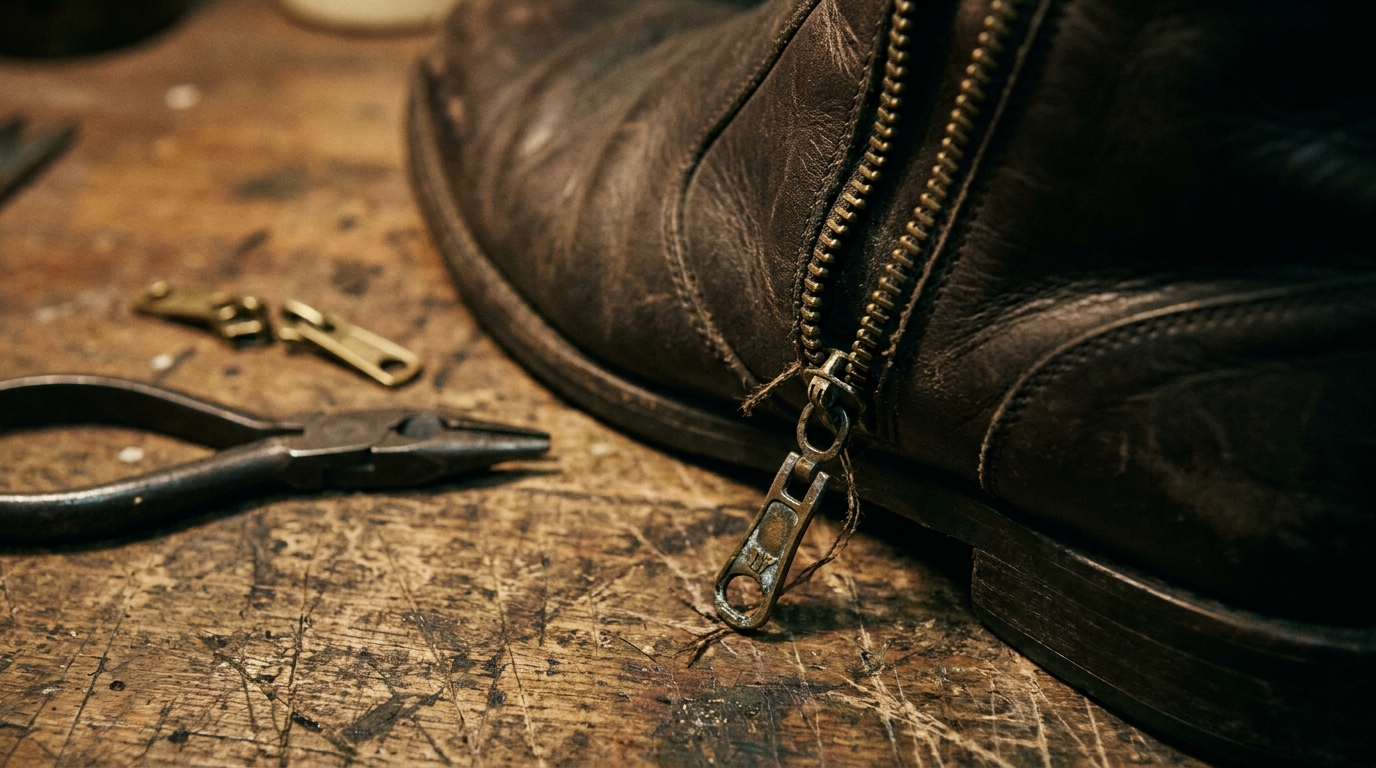
Most boots don’t die at the sole. They die — or get thrown out well before they should — because a zip jams, a buckle strap tears, or an eyelet pulls through and nobody thinks to ask whether it’s fixable. It almost always is.
That’s the frustrating part. A stitched sole failing is a real decision point: resole, patch, or retire the boot. A broken zip is usually just a ten-minute job that gets treated like a death sentence because it looks terminal — teeth gaping, slider hanging off the track, boot suddenly unwearable. Here’s what a cobbler can actually do with the three most common hardware failures, and where the line sits between a quick fix and a genuine write-off.
Zips: almost always the slider, rarely the whole zip
When a boot zip stops working, the fault is nearly always one of two things: the slider (the pull-tab mechanism that rides up and down) has worn out or come off its track, or a few teeth near the top or bottom have bent or separated. Either of these is a straightforward repair — a cobbler replaces the slider on the existing zip tape, or resets the end stops so the slider can’t run off the track again.
A full zip replacement — unpicking the old zip tape out of the leather and stitching a new one in — is a bigger job, but still a normal one for a shop set up for it, not a reason to retire the boot. The thing that actually rules out a zip repair is damage to the leather the zip is set into: if the panel around the zip has torn, delaminated, or rotted (common on boots that have sat damp for a long time), there’s nothing solid left to stitch the new zip tape to.
Worth knowing before you write a boot off over a “broken zip”: stiff, sticky sliders are often a maintenance problem, not a failure. A dry zip can be worked loose with a small amount of proper zip lubricant rather than forced — forcing a stuck slider is exactly how you snap it off the track in the first place.
Buckles: it’s usually the strap, not the buckle
Buckle hardware itself — the metal frame and pin — is tough and rarely the thing that actually fails. What fails is the leather strap around it: the pin hole elongates and tears through after enough flexing, or the strap has simply weakened at that one point of repeated tension. A cobbler’s fix here is normally to reinforce or replace the strap section carrying the buckle, sometimes with a new leather tab stitched or riveted in behind the existing one, rather than sourcing a new buckle.
A buckle is only a genuine write-off item when it’s physically cracked, badly corroded, or — on cheaper footwear — cast from a metal that’s fatigued and snapped outright. Even then, a cobbler can often source and swap in a comparable replacement buckle rather than needing to rebuild the whole strap. Worth asking rather than assuming, since stock varies shop to shop.
Eyelets: small hardware, real load
Eyelets take more repeated stress than most people realise — every lace-up cycle pulls against them, and boots get laced tighter than shoes. When an eyelet pulls through, it’s almost always because the leather immediately around it has worn thin or torn, not because the metal grommet itself failed. A cobbler’s usual fix is to reinforce the area (sometimes with an internal leather or fabric patch behind the panel) and reset a new eyelet through sound material, rather than just punching a fresh hole next to the torn one, which just moves the weak point sideways.
One pulled eyelet on an otherwise sound boot is a minor job. Several eyelets pulling through on the same boot, especially near the vamp where the leather flexes most, is usually a sign the upper leather itself is aging out — worth mentioning to whoever’s doing the repair so they look at the whole panel, not just the one hole.
When it genuinely isn’t worth fixing
Hardware repairs are cheap relative to a resole, which is exactly why they’re worth asking about before assuming a boot is finished. The exception is when the hardware failure is really a symptom of the leather itself giving out — torn panels, leather so dried out it’s cracking near every stress point, or a boot that’s already had multiple unrelated repairs. In that case, fixing the zip or buckle in isolation just buys a little time before the next failure turns up somewhere else on the same boot. A good cobbler will tell you this upfront rather than repairing hardware on a boot that’s genuinely done — it’s a fair question to ask directly if they don’t raise it themselves.
Common questions
Q: Can a broken boot zip actually be replaced, or do I need new boots?
A: In most cases it can be replaced or repaired in place — either the slider is swapped on the existing zip tape, or the whole zip is unpicked and a new one stitched in. It’s only a real problem when the leather panel around the zip has torn or rotted, since there’s nothing sound left to attach a new zip to.
Q: Is it worth fixing one pulled eyelet, or should I expect more to follow?
A: A single pulled eyelet on an otherwise healthy boot is a normal, inexpensive fix. If several are pulling through, especially near the flex point of the boot, it’s worth having the whole panel looked at — it can be an early sign the leather itself is thinning out, not just a hardware problem.
Q: My zip is stiff rather than broken — is that something I can sort out myself?
A: Often, yes. Try a proper zip lubricant made for the job rather than forcing the slider or using household oil, which tends to attract grit and make things worse over time. If it’s still jamming after that, get it looked at before it’s forced off the track altogether.