
How to Choose a Cobbler You Can Trust: A Buyer's Checklist
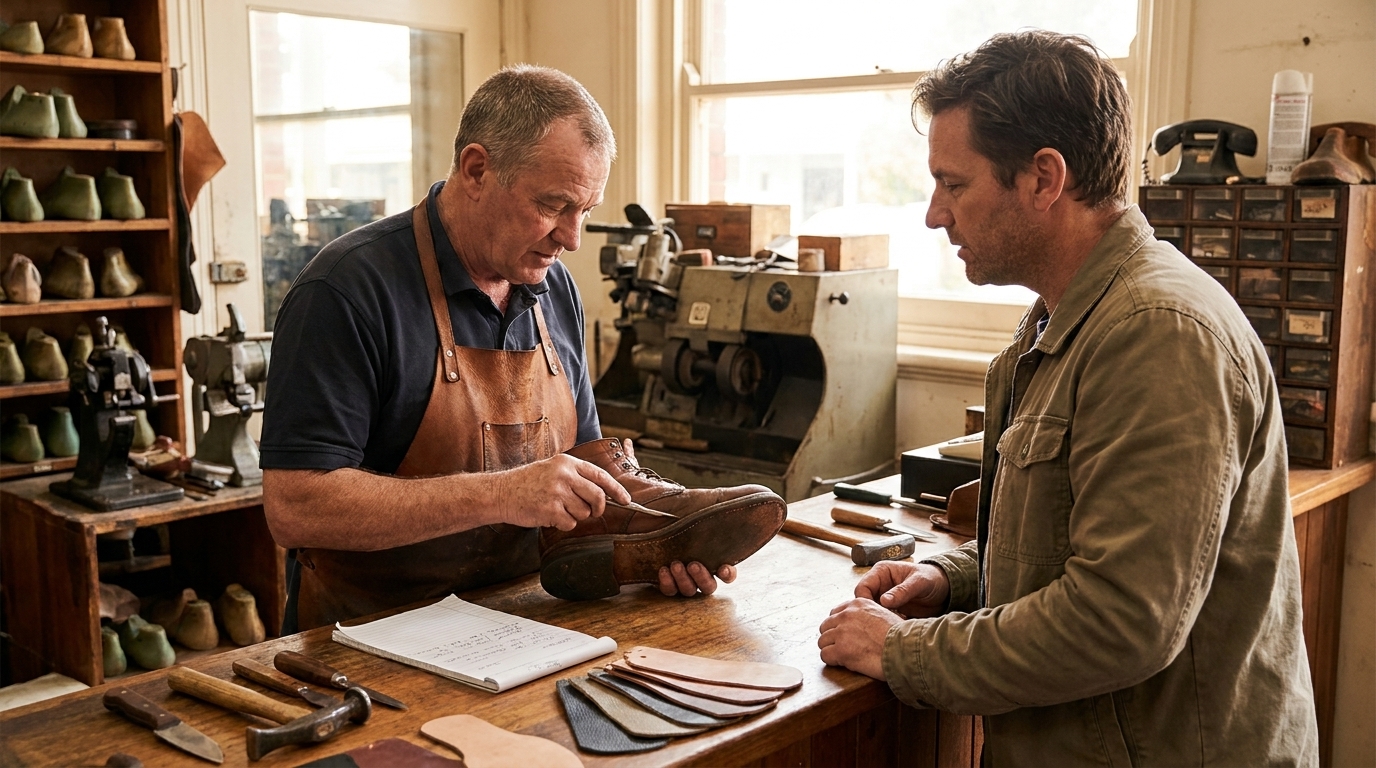
Handing your boots to a stranger with a knife and a sanding wheel is an act of faith. Get it right and you’ll have a repairer for the next twenty years. Get it wrong and you might get your soles back reglued with the wrong adhesive, or find out too late that “resole” meant something cheaper than you expected.
The trouble is that “cobbler,” “shoe repairer” and “leather repair” cover a huge range of skill and equipment — from a mall kiosk that mostly does key cutting and heel tips, to a proper bench with a stitcher, a sole press and someone who can rebuild a Goodyear welt from scratch. Neither is wrong for what it does. The mistake is sending the wrong job to the wrong shop. Here’s what actually tells you the difference, before you commit a good pair of boots to someone’s workbench.
Ask what they specialise in, not just what they offer
Most repairers list a menu: heel repair, resole, stitching, zip repair, key cutting, watch batteries. A long menu isn’t a red flag — plenty of good general repairers genuinely do all of it well. But it’s worth asking directly: “what’s most of your work?” A shop that mostly does key cutting and quick heel tips can still be perfectly competent at a straightforward resole, but you probably don’t want to hand them a hand-welted dress boot that needs the original construction respected. A shop that talks fluently about welt types, stitch patterns and sole compounds without you prompting them is a good sign they handle proper repair work regularly, not occasionally.
Let them tell you the construction before you do
This is the single best test we know of. Bring in a boot or shoe and ask, “how would you go about resoling this?” A repairer who actually knows their trade will look at the welt, flex the sole, maybe check the stitching pattern, and tell you what they’re dealing with — cemented, Blake stitched, Goodyear welted — before recommending a repair method. (We’ve written separately about what a Goodyear welt actually is and what a Blake stitch is, if you want to check their answer against a reference.) If a shop skips straight to a price without looking closely at the shoe, that’s not automatically wrong, but it does mean you’re relying on their judgement without seeing it demonstrated.
Get the price and the process before they start
A repairer worth using should be able to give you a firm quote, or a tight estimate, before they start work — and should tell you if they find something worse once they open the shoe up (a rotted midsole under a sole that looked fine, for instance). If a shop is vague about price until the job’s finished, that’s the moment to ask more questions, not less. It’s also fair to ask about turnaround time up front. Busy, well-regarded workshops often have a queue — a wait of one to a few weeks for a full resole isn’t unusual and isn’t a red flag on its own, but you should be told about it before you leave your boots there, not when you come back to collect them.
Look for evidence of the work, not just claims about it
Reviews help, but they’re easy to game and hard to verify from the outside, so treat them as one input rather than the whole picture. More useful, where you can get it: ask to see a recent repair, or look at what’s on the bench when you walk in. A shop that’s comfortable showing you half-finished work in progress is usually a shop that isn’t worried about what you’ll see. If a repairer has a visible track record — say, doing warranty or authorised repair work for specific bootmakers, or handling a particular niche like saddle stitching or orthotic work — that’s a stronger signal than a star rating, because it means someone with expertise has already vetted them for that specific skill.
Match the shop to the job
Not every repair needs the most specialised bench in town. Sole protectors, a scuffed toe, a stuck zip — most competent general repairers handle these well, and there’s no reason to drive across the city for it. But for anything that touches the original construction of a good pair of boots — a full resole on a welted shoe, rebuilding a heel base, replacing a damaged welt — it’s worth the extra step of finding someone who specifically works with that construction. Unique Cobbler in Surry Hills, Sydney, is a good example of what a well-rounded general repairer looks like on paper: resoles, heel repair, stitching, leather cleaning, stretching and dyeing all under one roof, alongside the key-cutting and watch-battery work that keeps a shopfront viable day to day. Whether a specific shop is the right fit for your specific pair is still a conversation worth having in person — but a broad, clearly listed service range is at least a sign they’re set up to handle real repair work, not just the quick stuff.
A few honest red flags
There’s no universal blacklist here, and a shop having one of these traits doesn’t automatically mean walk away — but each one is worth weighing. A repairer who won’t give any indication of price or timeframe until after the work is done. One who dismisses questions about construction rather than answering them. Visibly worn-out or mismatched materials sitting around that don’t match the quality of the shoes coming in. And, gently: a workshop that’s spotless and shows no sign of anyone actually working there during business hours is sometimes just tidy, but it’s worth a second look if everything else feels off too.
Quick FAQ
Q: Should I get a written quote before leaving my shoes with a repairer?
A: It’s good practice, especially for anything beyond a quick fix. A verbal estimate is fine for small jobs, but for a full resole or anything where the price could change once they open the shoe up, ask for it in writing or at least a clear text or email confirmation — Australian Consumer Law guarantees that repair services are delivered with due care and skill, and a written quote is your clearest record if that doesn’t happen.
Q: Is a generalist repairer worse than a specialist cobbler?
A: Not necessarily. A good generalist handles the bulk of everyday repairs — heels, zips, stretching, cleaning — perfectly well. The distinction matters most for work that touches the shoe’s original construction, like a full welted resole, where specific bench equipment and experience make a real difference.
Q: What if there’s no repairer near me?
A: Some workshops accept mail-in repairs, particularly for higher-value boots where it’s worth the postage either way. It’s worth asking directly, since not every shop offers it — check their listing or contact them before posting anything.