
Can Sneakers Actually Be Repaired? What a Cobbler Can (and Can't) Fix
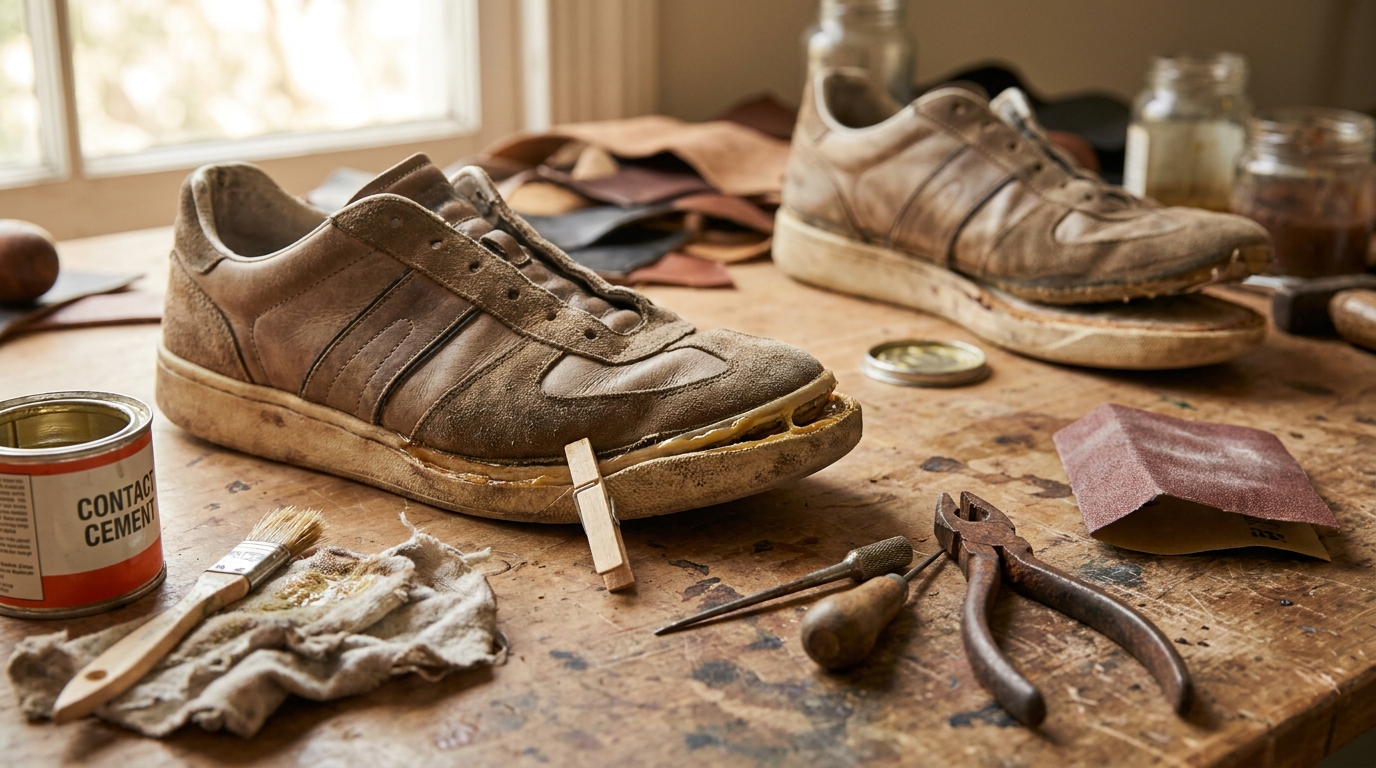
Ask a cobbler to resole a Goodyear-welted boot and they’ve got a clear, well-worn process to follow. Ask them to fix a pair of sneakers and the answer is usually “it depends” — not because sneakers are lower priority, but because they’re built differently, and that difference changes what’s actually repairable.
Most sneakers don’t have a welt at all. Instead of stitching the upper to a leather welt that’s in turn stitched to the sole, the upper is typically cemented (glued) directly to a foam midsole, which is then bonded to a rubber outsole. There’s no channel to unpick and no welt to unstitch and rebuild. That’s not a flaw in sneaker construction — it’s a different set of trade-offs, built for lighter weight and cheaper manufacturing rather than decades of resoling. It does mean a sneaker repair is a different conversation to a boot repair, and it’s worth knowing which side of that conversation you’re on before you take a battered pair to a repairer.
What a cobbler can usually fix
Sole and midsole separation. This is one of the most common sneaker failures, and also one of the most fixable: the outsole starts peeling away from the midsole at the edge, often at the toe or heel first. A repairer can clean out the old adhesive, reactivate or reapply a strong contact cement, and clamp the sole while it cures. Done properly, this is a genuinely durable fix, not a stopgap.
Worn-down tread. Some repairers can apply a thin rubber sole guard or half-sole over a worn outsole, similar to what’s done on leather dress shoes, extending the life of the tread before it wears through to the midsole. Fit and stack height are tighter on a sneaker than a boot, so this isn’t always practical or invisible — ask before assuming it’ll look factory-fresh.
Stitching on the upper. Popped stitching along a toe cap, a coming-apart seam on a leather or canvas panel, a separating eyelet row — these are straightforward for anyone with an industrial sewing machine, regardless of whether the shoe is a boot or a sneaker.
Zips, eyelets and lace hardware. Exactly the same repair as on a boot: broken zip sliders, torn eyelets, and missing lace hooks can usually be replaced or rebuilt.
Heel counters. The internal stiffener that holds the heel’s shape can collapse or wear through the lining above it, especially on sneakers worn without socks. A repairer can often rebuild or reinforce this from the inside.
Insoles and sockliners. A worn-out footbed is one of the cheapest and most satisfying swaps a repairer can do — it changes how a tired pair feels underfoot without touching the outside of the shoe at all.
What’s generally not worth it, or not possible
Collapsed cushioning. Once the foam in a midsole has compressed from wear, there’s no way for a repairer to restore its original bounce — foam doesn’t “re-inflate.” If the main complaint is that a pair feels flat and dead underfoot rather than visibly broken, that’s usually a sign it’s done its job and it’s time to replace it, not repair it.
Old, unworn sneakers that are crumbling or cracking on their own. Polyurethane-based midsoles are known to break down with age even with minimal wear — a pair pulled out of a cupboard after several years with a crumbling or flaking sole is showing material breakdown, not a repairable fault. No amount of gluing fixes a foam that’s degrading from the inside.
A full midsole rebuild. Unlike swapping a leather sole on a welted boot, most independent repairers don’t offer a full midsole replacement — it would mean remoulding a part that was originally injected or moulded to shape, which is outside what a repair bench does.
Uppers with no seam allowance left. Cheap, fully-bonded synthetic uppers that have torn rather than unstitched often don’t have enough material at the tear to restitch cleanly. A repairer can tell you quickly whether there’s something to work with.
Buying with repairability in mind
If long-term repairability matters to you in a sneaker (as opposed to a dress shoe or boot, where it’s a bigger factor), a few things tend to correlate with a more serviceable pair: leather or sturdy canvas uppers hold stitching and re-gluing better than very thin mesh; a simply cemented sole (rather than one moulded as a single unibody piece with the midsole) is easier for a repairer to work on if it separates; and a shoe with a separate, replaceable insole gives you an easy refresh without touching the shell of the shoe at all. None of this makes a sneaker as repairable as a welted boot — that’s not really what sneakers are for — but it’s the difference between a pair that’s worth patching up and one that’s genuinely disposable once it fails.
When to repair, and when to let it go
As a rough guide: if the problem is on the outside of the shoe — the sole edge, the upper, the eyelets, the zip — it’s worth asking a repairer. If the problem is how the shoe feels underfoot, with no visible damage to point to, that’s usually the cushioning telling you it’s finished. And if a pair that’s barely been worn is falling apart on its own, that’s age catching up with the materials, not something a repair fixes.
Unley Shoe Repairs & Giftwares in Unley, Adelaide, is one example of a traditional cobbler — over 25 years in the trade — whose services span resoling, stitching and sole protection, the kind of general repair skillset that covers most of what a sneaker actually needs. It’s worth calling ahead and describing the specific damage; a five-minute look often tells a repairer more than any general rule can.
A quick checklist before you write off a pair
Sneakers were never built to be resoled the way a welted boot is, and that’s fine — it’s just a different bargain. But “can’t be resoled like a boot” and “can’t be repaired at all” aren’t the same thing, and a lot of sneakers get thrown out for damage that a twenty-minute repair job would have solved.