
What Is a Blake Stitch? Boot Construction Explained
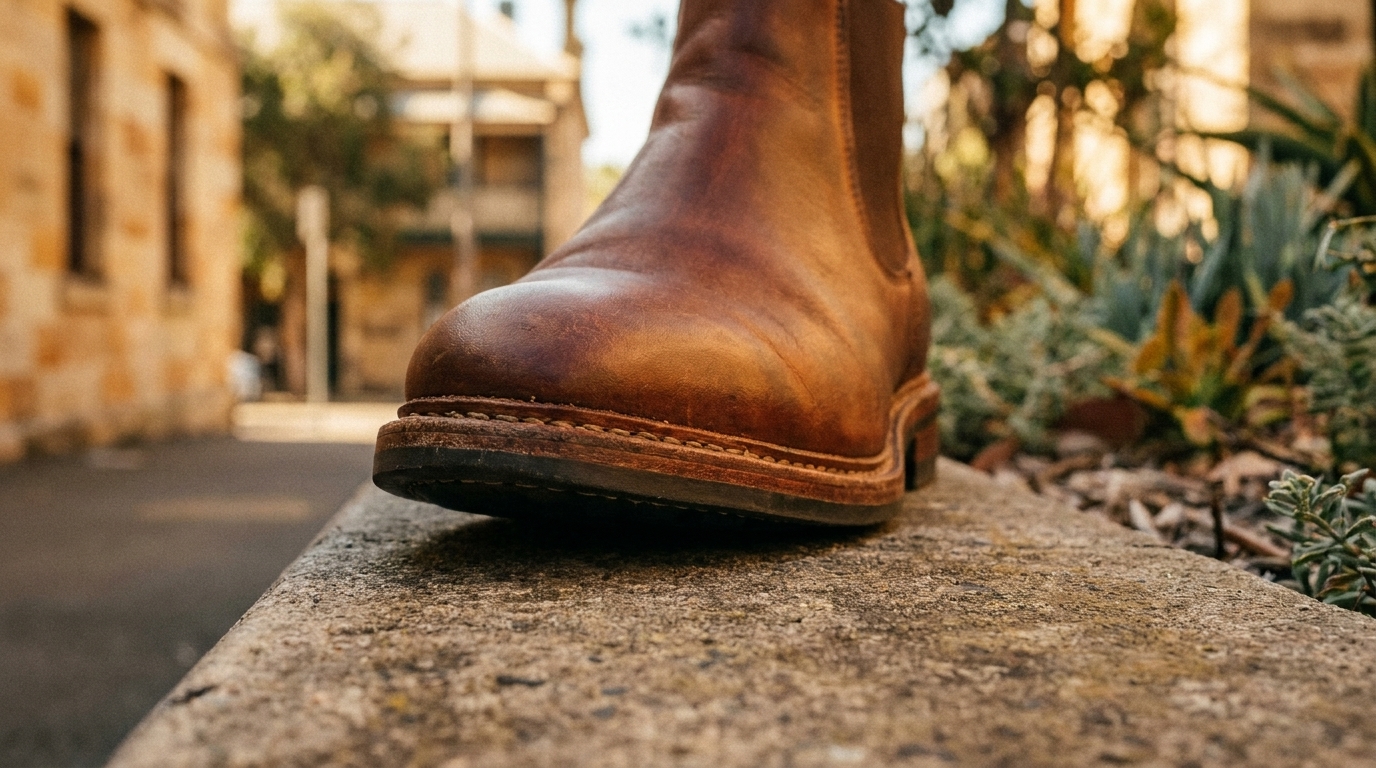
Blake stitch is the construction method behind the slim, close-cut profile you’ll see on dress boots and lighter leather boots that don’t want the bulk of a Goodyear welt. It trades some resoling life for a lighter, more flexible boot.
How a Blake Stitch Is Built
Unlike a welted construction, a Blake stitch skips the welt strip entirely and joins the sole straight to the upper and insole.
-
The upper is lasted (shaped around the last) and glued to the insole in the usual way.
-
A single row of stitching then runs from inside the boot, through the insole, through the folded edge of the upper, and out through the underside of the outsole — all in one pass.
-
This is done on a specialised Blake stitching machine, which reaches inside the boot to sew from the interior, a very different process from the external inseam used on a Goodyear welt.
-
Because there’s no welt strip or cork filling cavity to build up, the resulting sole sits noticeably closer to the ground, giving a sleeker, lower-profile boot.
Why It Matters for Boot Owners
-
Slim profile: Blake stitching allows a much closer-cut sole edge than a welted boot, which is why it’s the standard choice on dress and Chelsea-style boots where bulk looks wrong.
-
Flexibility: with no rigid welt strip around the perimeter, a Blake-stitched boot flexes more naturally underfoot from day one.
-
Resole potential: a Blake stitch resole is genuinely viable — a cobbler with the right machine can restitch a new sole through the same channel — but each pass puts another row of stitch holes through the insole, which limits it to roughly two to four resoles over the boot’s life, compared with five to ten or more for a Goodyear welt.
-
Water resistance: moderate at best. Because the stitching penetrates straight through from the inside to the outside sole, moisture can wick up through the stitch holes in sustained wet conditions, which is why Blake stitch is less common on boots built for genuinely wet work.
Blake stitch is common on Italian-made dress shoes and increasingly on slimmer Chelsea boots sold in Australia, where a lighter, closer-fitting silhouette matters more than heavy-duty resole life.
How to Spot One
Look inside the boot: a Blake stitch channel is visible in the sockliner or footbed area, running around the edge of the insole. From the outside, there’s no visible welt seam standing proud of the upper — the sole simply meets the upper in a slim, close line.
Related reading
For a full comparison against Goodyear welt and cemented construction, see What Is a Goodyear Welt? and The Anatomy of a Resole. If you’re deciding whether a Blake-stitched boot is worth resoling, our repair cost and feasibility guide covers current pricing and turnaround.