
Caring for Vegan and Synthetic Leather Shoes: What's Actually Different
Vegan leather isn’t leather, and it doesn’t age like leather
A lot of shoe care advice — including most of what we’ve written here before — assumes you’re dealing with a genuine leather upper: something with natural fibres, pores, and a finish that responds to oils, waxes, and conditioning. Vegan and synthetic uppers, whether that’s polyurethane (PU), PVC, or one of the newer plant-based materials like cork, cactus, or mushroom leather, don’t behave the same way, and using leather-care habits on them can do more harm than good.
The most common mistake is reaching for leather conditioner or shoe cream on a synthetic upper. Genuine leather conditioner is formulated to feed oils back into a porous, fibrous material. A PU or PVC coating isn’t porous in the same way — it’s closer to a thin plastic film bonded to a fabric backing — so conditioner tends to sit on the surface rather than absorb, and some formulations can actually soften or break down the coating over time. If the care label or box doesn’t say “suitable for synthetic materials,” it’s worth checking rather than assuming a leather product is safe to use.
How synthetic uppers actually fail
Where genuine leather tends to dry out, crack, and eventually need conditioning to stay supple, synthetic uppers fail differently: the PU or PVC coating delaminates from its fabric backing, usually starting at flex points — across the toe box, around the ankle, at the heel counter. Once that starts, it tends to spread, and unlike a scuff or a dry patch on real leather, it generally can’t be conditioned or polished back to good condition. Heat is the main accelerant worth knowing about: direct sun, a hot car interior, or a heater vent will age a synthetic upper faster than almost anything else, so where you store and dry the shoes matters more than what you clean them with.
If you’re not sure what you’re dealing with, the care label inside the shoe or the box it came in is the most reliable source — manufacturers are generally required to disclose upper material, and terms like “synthetic upper,” “manmade materials,” or a specific brand name for a plant-based leather are all signals to treat it as non-leather care from the start. A quick smell and flex test can help in a pinch too: genuine leather tends to have a distinct, slightly earthy smell and creases unevenly, while PU and PVC are closer to odourless and tend to crease in more uniform, repeating lines. Neither test is foolproof, and when it genuinely matters — a shoe you’ve paid a lot for, or one you’re about to condition for the first time — checking the label first beats guessing.
What actually helps
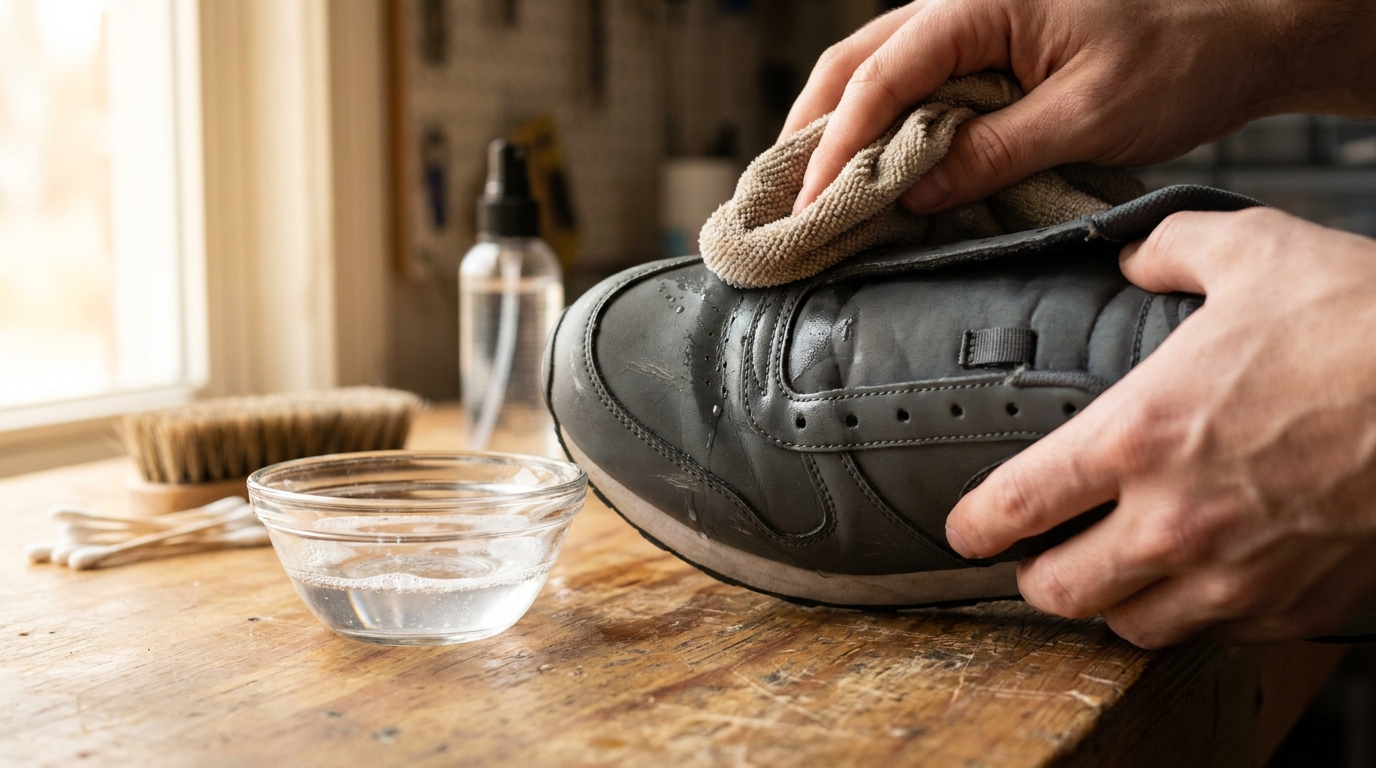
Cleaning is the area where synthetic uppers are genuinely easier to look after than leather. A soft brush or cloth with mild soap and water is usually enough for everyday dirt, and because there’s no natural fibre to overwet, you don’t need to worry about the same drying-out risk that comes with soaking leather. The main things worth doing consistently: wipe off dirt and salt before it sits and grinds into the coating, let shoes air-dry away from direct heat rather than near a heater or in full sun, and store them somewhere that doesn’t get hot — a wardrobe or shaded shelf rather than a car boot or a sunlit windowsill, which matters more in an Australian summer than it might elsewhere.
Unique Cobbler can usually still help with a synthetic pair — checking whether a coating is starting to delaminate, cleaning a stain properly rather than making it worse, or giving you an honest read on whether the upper is too far gone to be worth persisting with. That last point is worth being upfront about: synthetic and vegan uppers are very often cemented rather than welted construction, which — as we’ve covered separately when it comes to cemented boots — tends to limit how much a repairer can realistically do once the upper itself has failed, as opposed to the sole.
The sustainability trade-off, honestly stated
Vegan and synthetic materials are often chosen for animal-welfare or environmental reasons, and that’s a legitimate motivation — but it’s worth being honest that “vegan” doesn’t automatically mean “longer-lasting” or “better for the environment” in every sense. A well-made leather shoe can often be resoled and reconditioned for years; a synthetic-upper shoe, once the coating delaminates, is frequently at the end of its useful life regardless of how healthy the sole still is. That’s not an argument against synthetic materials — plenty of people have good reasons to choose them, and newer plant-based leathers are evolving quickly — but it does mean the “buy it, care for it properly, make it last” approach we usually recommend here has a shorter runway on some synthetic uppers than it does on a well-made leather pair, no matter how carefully you look after them.
The short version
Skip the leather conditioner, keep synthetic and vegan uppers away from direct heat, clean them with mild soap and water rather than leather-specific products, and get an honest opinion from a cobbler before assuming a delaminating coating can be fixed. None of that requires guesswork about which material you own — the care label or the box it came in will usually say, and when it doesn’t, treating the shoe gently and keeping it out of the sun is a safe default either way.