
Full-Grain, Top-Grain, or "Genuine Leather"? What the Labels on Your Shoes Actually Mean
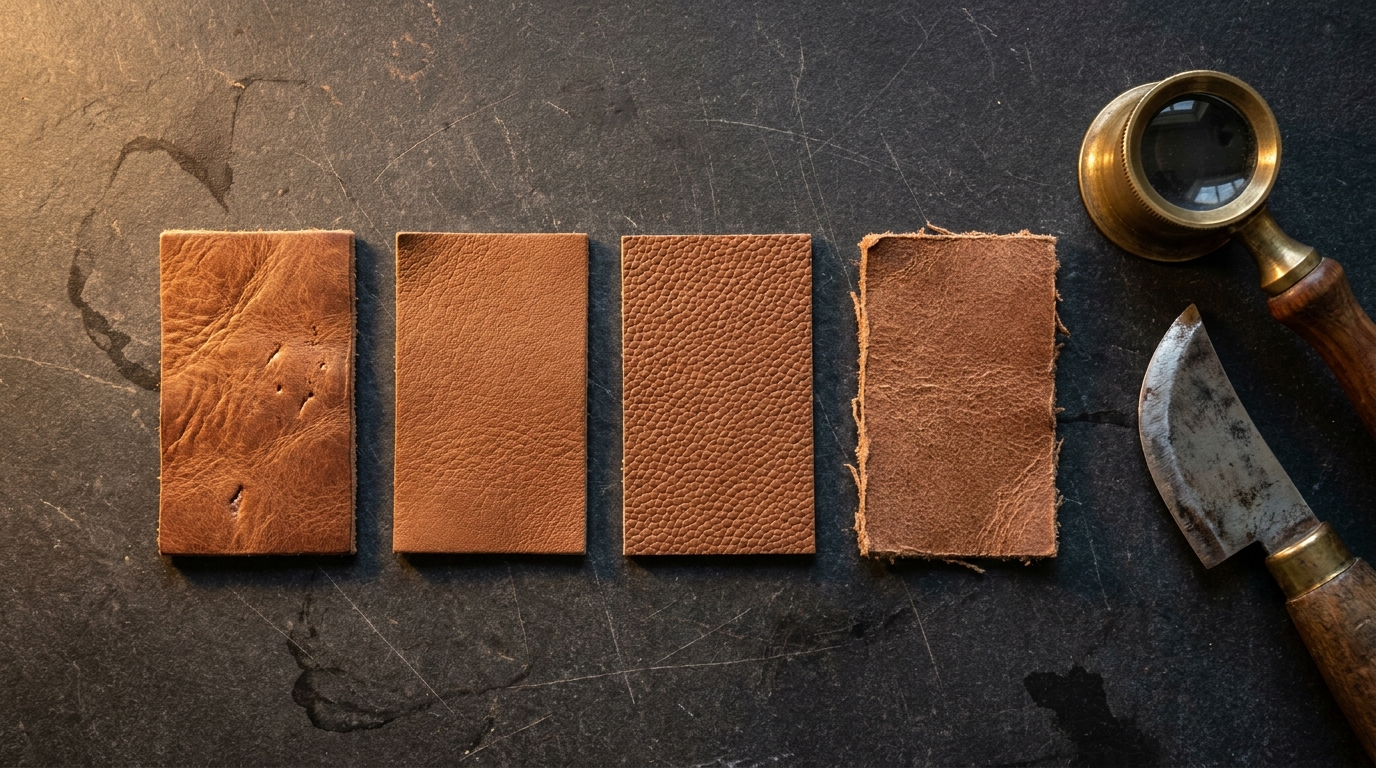
Full-grain. Top-grain. Corrected-grain. Genuine leather. Bonded leather. The shoebox says one of these, and it’s telling you something real about how the pair inside will age — and whether a repairer will be able to save it in three years, or shrug and tell you it’s not worth the effort. Most buyers never learn to read that label. Cobblers read it every day, because it’s often the first thing that tells them whether a resole is even possible.
None of these terms are marketing fluff, exactly — but they’re not consistently policed either, which is exactly why it pays to understand the hierarchy before you hand over your card.
The grading hierarchy, from strongest to weakest
Leather grading describes which layer of the hide a piece of leather comes from, and how much of that layer has been altered.
Full-grain is the top layer of the hide, left as close to natural as possible. The grain — the actual pore pattern of the animal’s skin — is still visible, including small natural marks. Because the tightest, strongest fibres of the hide sit right at the surface, full-grain is the most durable option and the one that develops a genuine patina rather than just wearing out. It’s also the hardest to fake, because that pore pattern is irregular in a way tooling struggles to replicate convincingly.
Top-grain is still the top layer, but it’s been lightly sanded and often given a corrected or embossed finish to even out natural imperfections. It’s thinner and more uniform-looking than full-grain, and slightly more resistant to staining because of the finish coat, but it loses some of the fibre strength and character that makes full-grain last so long.
Corrected-grain takes that a step further — heavier sanding to remove more of the surface, then an embossed, artificial grain pattern stamped on to imitate natural leather. It’s still a real piece of hide, just with most of the original surface removed and replaced with a printed texture.
“Genuine leather” is where things get slippery. It sounds like reassurance, but in the leather industry’s own hierarchy it usually sits below top-grain and corrected-grain — it typically means a lower, weaker layer of the hide (often a split, cut from beneath the top grain) that’s been heavily sanded, coated, and given an artificial texture to look presentable. There’s no requirement that “genuine leather” mean good leather; it only means the product contains some actual hide, as opposed to none.
Bonded or reconstituted leather is the bottom of the hierarchy: scraps and fibres from leftover hide, shredded, glued together with a polyurethane binder, and pressed into sheets. It can look convincing on a shelf. It does not behave like leather once it starts to wear — it tends to crack, peel, and delaminate rather than soften and age.
Why this matters more than the price tag
The grade doesn’t just predict how a shoe looks in year one. It predicts what a cobbler can do with it in year three.
Full-grain and most top-grain leathers can usually be cleaned, conditioned, resoled, and restitched more than once, because there’s enough sound material in the upper to hold stitching and flex without splitting. Corrected-grain can often still be repaired, though the artificial surface coat may crack or peel at flex points earlier than the grain underneath would.
Bonded leather is a different story. Because it isn’t a continuous hide, it doesn’t hold a stitch the way real leather does, and once the surface coating starts to flake there’s genuinely nothing underneath to work with — no grain to condition, no fibre structure to restore. It’s the material most likely to get a straightforward “not economical to repair” from a cobbler, not because they don’t want the work, but because there’s nothing left to save.
If you’re buying with the intention of having a pair resoled down the track rather than replaced, the grade on the label is a better predictor of that outcome than the brand name next to it.
How to check before you buy, without cutting anything open
You can’t always verify grade with total certainty in a shop, but a few checks go a long way:
Look at the grain pattern up close. Natural, irregular pore patterns with small variations are a good sign. A pattern that repeats identically every few centimetres is embossed, not natural.
Check the cut edge, if you can see one — at a seam, a tongue, or a vamp overlap. A cross-section of real, full-thickness leather looks fibrous and dense. A thin, uniform, almost paper-like edge is a sign of a split or bonded material.
Do a gentle bend test. Full-grain and most top-grain leathers flex and want to return to shape. Bonded leather often creases sharply and holds the crease, because the coating doesn’t behave the same way as natural fibre.
Smell it. This one is unscientific but not useless — natural leather has an earthy, slightly oily smell. A strong, flat chemical or plastic smell is a reasonable flag for a heavily coated or bonded product.
Treat the label as a starting point rather than gospel, and treat price as a loose correlate rather than proof — a high price doesn’t guarantee full-grain, and grading terminology isn’t uniformly regulated the way some other textile labelling is — in the US, for instance, leather labelling only has to meet the FTC’s Leather Guides, which set disclosure rules but no quality floor — so it’s worth checking rather than assuming.
The sustainability angle
None of this is really about snobbery over materials. It’s about buying something that has a second and third life ahead of it, rather than something engineered to be replaced. A full-grain leather shoe that gets resoled twice and lasts a decade has a genuinely smaller footprint than three pairs of bonded-leather shoes that get binned when the coating starts to flake — no invented statistic required to see why. It’s simply a question of how many times a pair can realistically go back to a repairer before there’s nothing left worth repairing.
If you’re not sure what you’re looking at — on a pair you already own, or one you’re considering secondhand — a cobbler can usually tell in seconds what would take you a magnifying glass and a bend test to guess at. It’s worth asking before you buy, not just when something’s already gone wrong.