
Full-Grain vs Corrected-Grain Leather: What the Swing Tag Isn't Telling You
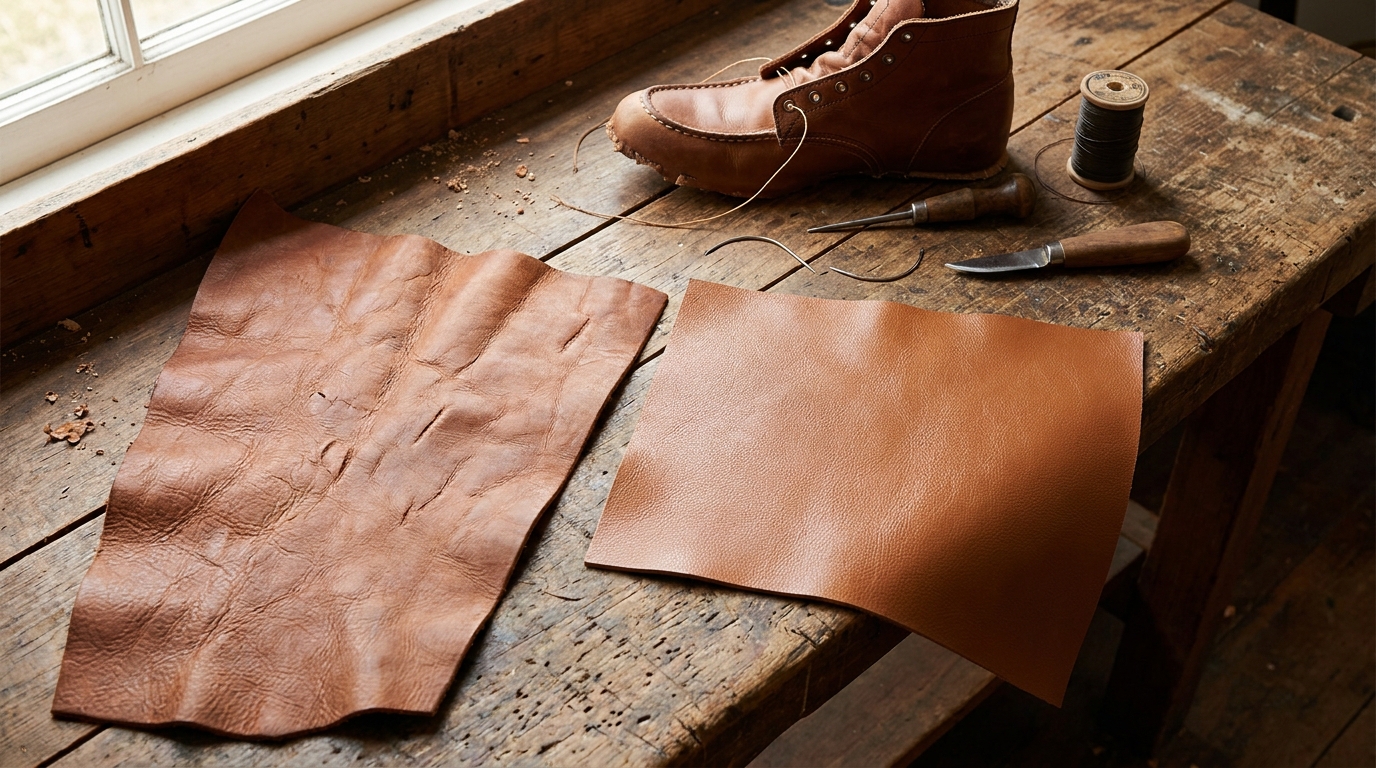
If a shoe or boot is going to last, and be worth repairing when it eventually needs it, the leather it’s made from matters more than almost anything else on the swing tag. Yet leather grading is one of the least understood parts of buying footwear — partly because the terms sound similar, and partly because retail labelling isn’t always required to spell out the difference. “Leather upper” can mean several quite different materials wearing the same name.
This isn’t about snobbery over what counts as “real” leather — corrected-grain and even bonded leather are genuine materials with a place in the market, usually at a lower price point. It’s about knowing what you’re actually paying for, and what that choice means for how the shoe will look in a year, and whether a repairer can do much with it in five.
The four grades, in plain terms
Full-grain leather uses the hide’s outer layer as it comes off the animal, with the natural grain intact. It isn’t sanded or buffed to remove scars, insect bites or growth marks — those imperfections stay, which is exactly why full-grain leather looks a little different from pair to pair. Because the tight fibre structure at the surface is untouched, full-grain is generally the most durable and breathable of the four grades, and it develops a patina — a gradual darkening and softening of the surface — with wear and conditioning.
Top-grain leather also comes from the top layer of the hide, but the surface has been lightly sanded to even out those natural marks, then usually given a thin protective finish. It’s thinner and more uniform-looking than full-grain, still a good, genuine leather, but the sanding removes some of the surface fibre that gives full-grain its long-term durability and ageing character.
Corrected-grain leather goes a step further: the natural grain is sanded off more heavily to erase flaws, and an artificial grain pattern is embossed back on, then covered with a pigmented finish coat to create a uniform, blemish-free surface. This is what a lot of mid-range and budget leather footwear actually uses. It’s real leather underneath, but the surface you touch and see is a manufactured layer sitting on top of it.
“Genuine leather” and bonded leather are where labelling gets genuinely misleading. “Genuine leather” sounds reassuring, but in the footwear industry it’s typically the lowest of the split layers taken from a hide — thinner, weaker, usually corrected and heavily finished to be usable at all. Bonded leather isn’t a hide layer at all: it’s leftover leather fibres and scraps bonded together with an adhesive backing, then given a printed leather-look surface. It’s the least durable option by a wide margin.
How to tell them apart before you buy
Manufacturers aren’t always required to specify grade on the tag, so a bit of your own inspection helps:
-
Look for natural variation. A perfectly uniform, pore-free surface across every pair on the shelf is a sign of a corrected or embossed finish — real full-grain hides vary slightly because animals aren’t machine-stamped.
-
Check the cut edge, where the sole meets the upper or inside a tongue. Full-grain and top-grain leather usually show a fibrous, slightly rough cross-section. A corrected or bonded material often has a smoother, more synthetic-looking edge, sometimes with visible layering.
-
Feel for a coating. A thick, glossy, almost plasticky surface finish is doing a lot of work to hide what’s underneath. Full-grain leather has some natural sheen but a noticeably different hand-feel — less rubbery, more fibrous.
-
Ask what “leather” means on the tag. A shop assistant who can tell you the grade, or point you to it on a product page, is a good sign the brand knows and isn’t hiding a corrected or bonded material behind the word “leather.”
-
Weigh the price against the claim. Full-grain leather costs more to produce than corrected-grain or bonded leather. A “full-grain” claim at a price point where that would be commercially unusual is worth a second look.
Why it matters once something goes wrong
This is where the grade stops being a style question and becomes a repair question. Full-grain and top-grain leather can generally be conditioned, re-dyed, and have surface scuffs worked out, because the material a cobbler is touching is the same material all the way through the affected layer. Corrected-grain leather has a pigmented coating between you and the actual hide — a deep scratch or crack can go through that coating and expose a different-looking layer underneath, and conditioning products that soak beautifully into full-grain can simply sit on top of a corrected finish instead of penetrating it. Bonded leather doesn’t really take conditioning or repair at all; once the printed surface cracks or peels, there’s no deeper leather layer to restore.
None of this means corrected-grain or bonded leather shoes are a bad buy — for some budgets and some uses, they’re a reasonable trade-off. But it does mean the honest question to ask before buying is not just “is this leather,” but “which kind, and am I buying it expecting the durability of a grade it isn’t.”
If you’re ever unsure once you’ve got a pair home, this is exactly the kind of thing an independent repairer can usually tell at a glance, by feel and by looking at a cut edge, well before anything’s gone wrong. On the Mend Shoe and Bag Repairs, an independent repairer in Fitzroy, Melbourne listing resoling, stitching and leather cleaning among its services, is one of the businesses in our directory worth a look if you’re local and want a second opinion before or after a purchase.
A five-point checklist before you buy
Buying leather footwear well is mostly about matching expectations to material. A corrected-grain pair bought and worn knowing what it is will serve you fine. A full-grain pair bought by mistake as “genuine leather” and then treated like it can’t be conditioned or repaired is the outcome worth avoiding — and it’s avoidable, with about thirty seconds of looking before you pay.